Wednesday, January 2, 2013

Anuradhapura: A Brief History of an Eternal City


Located in the North Central plains of Sri Lanka, Anuradhapura is the heartland of its irrigation civilization. Written chronicles attest to city with a proud history of nearly 2500 years. Archeological evidences suggest an even longer history.

According to the Mahavamsa, the ancient chronicle of Sri Lanka, Anuradhapura was established by one of the followers of Vijaya, the prince who was exiled from his kingdom in India and established a kingdom in this island. Anuradha, the founder of the city came up Kadamba Nadee, which is called Malvathu Oya, and established a village by his name at the site of the current city.

However, the chronicles are silent about any settlement beyond the founding of this Anuradhagrama (Village of Anuradha) in the 6th Century B.C. However, archeological excavations have revealed that Anuradhapura area was a thriving settlement where people knew of farming, animal husbandry, pottery and even metallurgy several centuries before the ‘founding’ by Anuradha. If the ancient chronicle is to be believed word by word, it raises questions as to what happened to a thriving community. Such a civilization cannot ‘vanish in to thin air.’

To return to the chronicle Mahavamsa, it was king Pandukabhaya who made Anuradhagrama his capital and expanded it to a modern city, Anuradhapura. This was in the 4th Century B.C. Anuradhapura was to remain the capital city of ancient Sri Lanka and also of Rajarata (The Abode of Kings) for around 1400 years. Rajarata was one of the three regions of ancient Sri Lanka. A number of invaders overran the city and either plundered it or chose to rule the part of the country they occupied from it. But, there were no reasons to abandon it. The Chola invaders occupied the city and Rajarata in 993 A.D. and moved the capital to Polonnaruwa, South East of Anuradhapura, for security reasons. Even after this event, the Sinhalese people had a spiritual attachment with the city as it was home to many sacred religious sites including the Jaya Sri Maha Bodhi and Ruwanweliseya. After the invaders were driven out, the Sinhalese kings chose to keep Polonnaruwa as the capital for practical purposes. But Anuradhapura, the spiritual capital of the Sinhalese people, was not totally abandoned until the Sinhalese kings chose to leave the North Central plains altogether in the 13th Century.

The Capital of All Buddhists

Anuradhapura can be considered to be the capital of all the Buddhists in the world until the 13th Century A.D. The ancient chronicles tell us that Emperor Asoka sent his son, Arhat Mahinda Thero, as an emissary from his capital to Sri Lanka. It is said that Arhat Mahinda’s mission brought Buddhism to the country. However, there is enough evidence to suggest that the ancient Sri Lankan people had at least some knowledge of Buddhism before this event. Nevertheless, according to the chronicles, it is with this event that Buddhism found royal patronage in the country.

Not long after, according to the chronicles, a sapling of the sacred Bodhi Tree was brought to the island from Bodh Gaya by Emperor Asoka’s daughter Ven. Sanghamitta. It was planted in Anuradhapura and still stands as the living symbol of Lord Buddha. The Bodhi Tree at Bodh Gaya was destroyed subsequently and it was a sapling from the sacred tree in Anuradhapura which was taken there to be planted thereafter.

The Sacred Bodhi Tree (Jaya Sri Maha Bodhi). The tree with golden supporting pillars is one of the two branches of the original tree. The other is a smaller branch. The rest of the trees are surrounding Bo Trees. Photo by Chamara Sumanapala (June 10, 2012)


In 4th Century A.D., during the reign of King Kirthi Shri Meghavanna, the Sacred Tooth Relic of Lord Buddha was brought to Sri Lanka by Princess Hemamala and Prince Dantha from Kalinga in India. It was placed in a “Dalada Maligawa” (Temple of the Tooth) in Anuradhapura and became a symbol of kingship. As such, it was taken from capital to capital by Sinhalese kings, ultimately ending up at Kandy (Temple of the Tooth, Kandy) during the 16th Century. But, until the 10th Century, it resided in Anuradhapura.

With these two symbols of Lord Buddha residing in the City, Anuradhapura was the unrivalled capital of the Buddhists in the entire world.

A City of Monasteries

Anuradhapura was a city of monasteries. The sheer size of the monasteries can be imagined by the ruins in the sacred city seen today. For instance, when King Dutugemunu built it as the chapter house of the monks of Mahavihara, the Lovamahapaya (The Brazen House) had thousand rooms in its nine stories. It was covered with gilt bronze sheets, giving it its name. At that age, it was a gigantic building by scale. Later it was demolished by fire and was subsequently rebuilt and was repaired and enlarged from time to time. Today, there are 1600 stone pillars at the site.

Lovamahapaya with Ruwanweliseya at the Distance: It would have been a much better view without the telephone wires. It must have been still better when the Lovamahapaya was 9 storied during King Dutugemunu's time. Photo by Chamara Sumanapala (June 10, 2012)


Mahavihara was the early centre of Theravada Buddhism in Sri Lanka. Ruwanweliseya, built by King Dutugemunu (161-137 B.C.), was its main stupa and even today it is known simply as the Mahathupa or the Main Stupa. Rising majestically in pristine white, it is a sight to relish. At night, it is even more beautiful.

Ruwanweliseya or the Mahathupa (The Great Stupa): With rain clouds in the background, I feel that it gives a picture of Light and Darkness. Photo by Chamara Sumanapala (August 11, 2012).


There were many smaller stupas in Mahavihara, including the Thuparama, the first stupa said to have been built in Anuradhapura.

However, two main schisms occurred in 1st Century B.C. and 3rd Century A.D. which established two more monasteries. The first of these schisms occurred when King Wattagamini Abhaya or Walagamba established Abhayagiriya and offered it to Kuppikala Thissa Thero. Usually, donations and offerings of anything from alms to monasteries to Mahasangha were not offered privately to a particular monk. But the fact that Kuppikala Thissa Thero accepter this private offering prompted the Mahavihara from expelling him. Thereafter, he established his own order of monks at Abhayagiriya.

In 3rd Century A.D., King Mahasen, who had a grudge with the Mahavihara, expelled its monks and destroyed much of it and reportedly turned the land into farmland. He also burnt heaps of books which were in the Vihara. He established a new monastery, Jetavanaramaya, and built a stupa, rivaling both Abhayagiriya and the Maha Stupa in size and height. With a height of 400 feet, Jetavanarama Stupa is regarded as the tallest building made of brick in the ancient world. It is also the third highest building made in the ancient world. Only two of the Pyramids in Giza are higher than it.

Mahavihara was later rebuilt by King Mahasen, who realized his mistakes. But, it most probably did not reach its past glory ever. By early 5th Century, when Ven. Fa Hsien, a monk from China, arrived in Sri Lanka, Abhayagiriya had 5000 monks and Mahavihara 3000. Ven. Fa Hsien arrived to study the Thripitaka (Pali Canon) which includes Buddha’s teaching. This shows that Anuradhapura was a famous centre of learning in the ancient world, although little is said about that aspect. It is one of many facets of life in ancient Anuradhapura in need of further studies today.

Not a Fortress Town

Although Anuradhapura is said to have its own walls, gates and defences, it never was subjected to prolonged sieges. It suggests that Anuradhapura was not a fortress city in its true meaning. Battles for the kingship were usually waged outside the city, elsewhere in the country. If it was decided in Anuradhapura itself, it was through a palace coup. For instance, by the time King Dutugemunu reached Anuradhapura to oust King Elara, the bulk of the latter’s armies had been already decimated elsewhere in a protracted war of sieges and open battles.

Obviously, with so many monks within the city, it was never a fortress city, but a place of monasteries and learning. Only through totally abandoning the monasteries could the city be defended in a prolonged siege, even if there were sufficient defences built around it. However, it is obvious that there were some defence mechanisms and tight defences for the royalty residing in the Inner City. However, the Kings of Anuradhapura were confident enough to move among his subjects when the political situation was stable, especially during religious events. Religious sites were sacred places not to be desecrated even during war.

Irrigation to Support the Population

Ancient Sri Lanka was undoubtedly the irrigation centre of the ancient world. Not anywhere in the world will you find such a huge number of manmade reservoirs as in Rajarata and Ruhuna in Sri Lanka. Some of them are still hidden in the jungles, especially in Ruhuna. These reservoirs used a unique technology and cannot be equaled to any other reservoir in the world. Hence, its more appropriate to use the Sinhalese word for them, wewa.

The first wewa built by Sri Lankans is said to be Abhaya wewa, also known today as the Basavakkulama. Reportedly built by King Pandukabhaya in the 4th Century B.C., it is located near Ruwanweliseya. Today, its area is 225 acres. Therefore, it is smaller than the gigantic wewas built by ancient kings of Sri Lanka. However, the multitude of smaller wewas performed a crucial role in the irrigation network which has not been sufficiently appreciated. Furthermore, there are accounts in the chronicles that claim the existence of reservoirs even before Pandukabhaya became the king. However, enough details about them have not been unearthed, at least for now.

Ancient Sri Lanka was self sufficient in the basic needs of its people. Enough food was produced to support a large population especially during politically stable times. There are accounts of droughts but the majority of the people managed to survive them. Obviously Anuradhapura was not self sufficient in food, as any city would be. But with a very advanced irrigation system and flat land to grow paddy, the surrounding areas were able to feed the city with little difficulty.

Abandonment and “Rediscovery”

In the 13th Century, Anuradhapura and the Rajarata as a whole, was abandoned. There is no consensus as to what the exact reason was. Yet, it was political instability which was the root cause. Even after the ‘abandonment’, a small number of people lived there, protecting the Maha Bodhi through sheer dedication. Pilgrims still arrived, bringing in firewood to light fires at night to protect the Sacred Tree from elephants. In the 18th Century, a stone wall was built around the Boghi Tree with the patronage of the King, Kirthi Shri Rajasingha (1747-1782).

Anuradhapura attracted the attention of archeologists including H. C. P. Bell, who subsequently became the first Commissioner of Archeological Department of Sri Lanka, in the late 19th Century. Archeological excavations have unearthed many ruins of the ancient city. Meanwhile, repairing the ancient irrigation works and establishment of settlements were carried out throughout the early part of the 20th Century. A new town was established to administer the growing population.

Some of the more known sites were renovated. Ruwanwaliseya was renovated by 1940. Renovation of Jetavanarama was finished a few years back and work at Abhayagiriya is still in progress. Excavations are continuously carried out in several places at the ancient city. But, even in Anuradhapura itself, let alone the other parts of Sri Lanka, there are many secrets still hidden beneath the earth, waiting to be unearthed.

Friday, December 14, 2012

China Mourns Victims of the Nanking Massacre


Yesterday marked the 75th anniversary of the capture of Nanking, the capital of Nationalist China by the Japanese forces during the Second Sino-Japanese War. This mark the beginning of several weeks of sheer brutality by the Japanese soldiers towards the hapless population. No one really knows how many people died. The official Chinese figure of 300,000 given in official media seems too high. It is estimated that more than 250,000 people resided in the city when the Japanese arrived on December 13, 1937. A series of memorial services were held in the city to commemorate the victims of the massacre.

Japanese militarists and certain economic conglomerates were not content even with the takeover of Manchuria and the neighboring provinces in 1931. The ever expanding industries needed raw materials and markets. While Manchuria was a valuable prize, even more valuable resources were supposed to be in China. Meanwhile, the Chinese Nationalists or the Kuomintang (KMT) was consolidating its hold over the rest of the country under its leader, Generalissimo Chiang Kai-Shek. According to some analysts, the Generalissimo was himself spoiling for a fight. For both sides, only an excuse was sufficient.

The excuse came on July 7, 1937, at the Marco Polo Bridge. Japan responded with strong military forces, totally out of proportion for a small skirmish. It was obvious that Japan had been quite prepared to launch the offensive. The Japanese struck from two directions. Their forces in Manchuria and the nearby regions launched an offensive in the North. Meanwhile, Japanese forces attacked Shanghai. At this latter battle in Shanghai, the Chinese thwarted the Japanese hopes of a short campaign by holding out for three months. By November, the Japanese had taken Shanghai with considerable losses.

However, the Chinese casualties at Nanking were staggering. Chiang Kai-Shek had lost some of his best troops in the battle. When the Japanese made their move towards his capital up the Yangtze River, he was reluctant to make a stand there. Deciding that Nanking cannot be defended, he chose to abandon the city. On December 7th, the Generalissimo left the city and by the 12th, the last effective military forces also pulled out. Along with the troops, around three quarters of the population had also left. The remaining citizens awaited the entrance of the Japanese forces.

And enter they did! The Japanese troops indulged in an orgy of murder, rape, looting and arson, directed at the civilian population. There were reports of systematic torture. The killing spree did not abate for at least two weeks. Things got a little bit better by the next year. By that time, hundreds of thousands of powerless people had been killed.

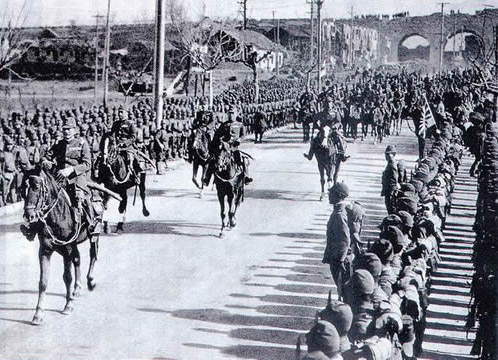
Although the “Nanking massacre” was carried out by the ordinary soldiers and those of lower ranks in the Imperial Army, the higher ups knew what was going on. An Army cannot engage in a self indulged killing spree for weeks without the superior officers knowing. Some soldiers later claimed that they were actually acting on orders from above. The Commanding Officer of the Japanese forces, Iwane Matsui, didn’t arrive in the city until a few days due to his poor health. Nevertheless, he was well aware of what was happening and did not or could not do anything to stop it. He was implicated for his inaction after the war and was hanged in December 1948.

Iwane Matsui Rides into Nanjin, Wikimedia Commons


There is no clear explanation to the motives of the Japanese Army in carrying out a massacre of this nature or this proportion. One possible motive could have been the terrorizing of the Chinese into subjugation. If it was an objective, the Japanese failed miserably. Rather than being terrorized, the Chinese people fought on and the Sino-Japanese War dragged on. The Japanese soldiers were better trained, had better weapons and were led better than the Chinese. They won the majority of the battles in the next years. But the ultimate victory was out of their reach. The Chinese had a large reserve of manpower and a huge area where they could move about and retreat, if necessary. On top of it, the KMT and the Communist forces were cooperating against the common enemy and the Japanese were being constantly harassed by the Communist guerrillas.

The Chinese resorted to a scorched earth policy to deny the enemy of food and other supplies. The Nanking massacre enhanced the will of the people to resist, rather than the opposite. The campaign also failed to deliver the expected goods to the Japanese industries. Japan was forced to look elsewhere for success, only to be brought down ultimately. Her military forces could not hope for a long drawn campaign over a huge area encompassing East Asia and Western Pacific. They overextended themselves and lacked the necessary troops for an effective victory in China, or anywhere else. As Mao Tse-tung once pointed out, “China is like a gallon jug which the Japanese are trying to fill with half a pint of liquid. When her troops move into one section, we move to another. And when they pursue us, we move back again.”

The Nanking massacre, also referred to as “The Rape of Nanking”, was a case of sheer brutality by the Japanese forces. However, this became the norm in many Asian regions which they conquered. Even then, perhaps in no other place did the Japanese behave worse than in Nanking. The disturbing fact was that these atrocities in Nanking and elsewhere were carried out by the regular army and not by some fanatic crowd such as the SS, SA or the Gestapo. For example, in Nazi controlled regions in Europe, it was the SS or other groups-which followed in the wake of the regular army-that carried out the bulk of the German atrocities during the war. The Nanking massacre and other atrocities were carried out by the same army which had behaved commendably just thirty years back during the Russo-Japanese War. In that war, any Japanese soldier who harmed civilians was inviting severe punishment on himself.

The Nanking massacre is a stumbling block for the improvement of Sino-Japanese relations even today. The Chinese consider it to be a “Forgotten Holocaust.” On the other hand while some Japanese nationalists argue that the intensity of the “Nanking massacre” has been grossly exaggerated, more hard-line nationalists, such as the popular former governor of Tokyo, Shintaro Ishihara, claim that the “Nanking massacre” never even occurred. With the general elections just two days away and the nationalists poised to record substantial gains, the abrasive Sino-Japanese relations are unlikely to get better in the near future.

Monday, October 8, 2012

Ernesto 'Che' Guevara was Betrayed by his own Mistakes


After his capture on the previous day, Ernesto 'Che' Guevara was executed by the Bolivian security forces on October 9, 1967, at La Higuera. Thus ended the brief but eventful life of the best known Marxist revolutionary of the world. After meeting Fidel Castro in Mexico, he played a vital role in the Cuban revolution which ousted Fulgencio Batista. After this victory, Guevara held an important position in the government of his adopted country. Meanwhile, using his experiences as a guerrilla fighter, he wrote several books including the well known manual "Guerrilla Warfare."

While he could have enjoyed the comforts of life as an important personality in Cuba, Che chose the hard road of a revolutionary with the support of his friend Fidel. He took part in two other campaigns in Congo and Bolivia which were both unsuccessful. Congo was a fiasco. Bolivia cost him his life.

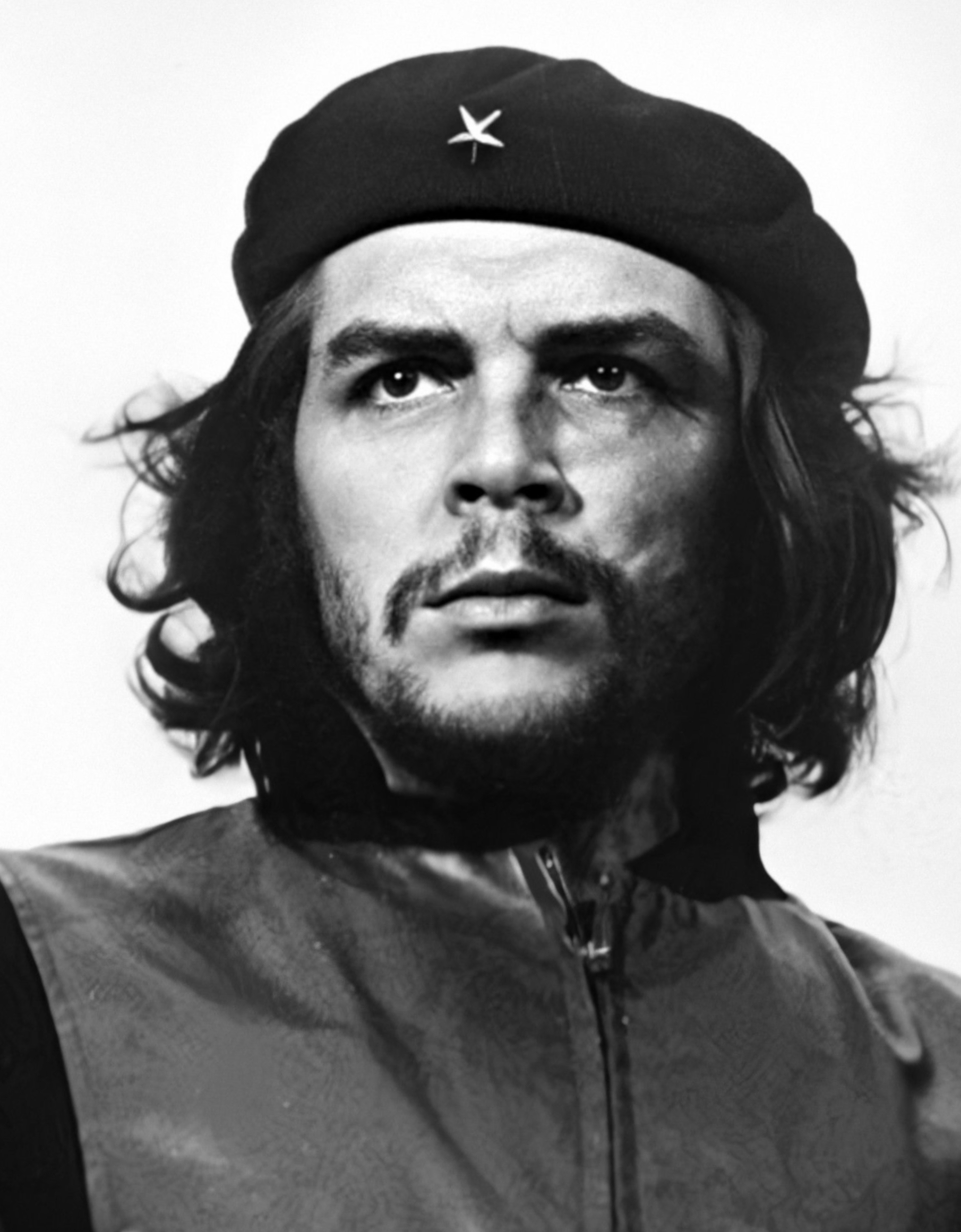
Che Guevara at the funeral for the victims of the La Coubre explosion by Alberto Korda. (Popularized cropped version of Guerrillero Heroico) Wikimedia Commons


One major reason for the failure of the latter campaigns was the attempt to repeat the Cuban experience in those countries. The modus operandi of the guerrillas was to enter the relatively inaccessible hinterland and slowly gather local support. It was hoped that a small but well trained guerrilla force would act as the vanguard of the revolution. This was what they employed in Cuba and was successful there with the aid of some advantages the guerrillas had. Che Guevara remarked in his book "Guerrilla Warfare" that "[I]t is not necessary to wait until all conditions for making revolution exist; the insurrection can create them."

While this may be true, it does not assure that an armed group championing the cause of the people will always attract popular support. This is a fact that Che Guevara overlooked and ultimately payed the prize for.

In Cuba, after some initial blunders and misfortunes, the guerrillas found their way and moved on. Initially, the local population was vary and skeptical about the guerrillas but slowly they began to support them. Of course, Fidel's men were helped by the New York Times reporter Herbert Matthews who interviewed the rebel leader and published three articles which turned the guerrillas into heroes. With the passage of time, local population increasingly supported the rebel forces which started their march towards Havana.

However, both in the Congo and in Bolivia, Che Guevara could not garner enough popular support despite almost all other condition for a successful rebellion was more or less evident on the ground. The people felt that the guerrillas were foreign to them, and as for the Cubans led by Che, they were. Many could not understand the internationalism of the Cubans involved. The Cuban revolution was led by a Cuban and while Guevara was not a native Cuban he was not the overall commander of the revolutionary forces either. He was just taking part, albeit a big part, in the war. In contrast, he was leading a campaign in Bolivia. The fact that a Cuban led the movement in Bolivia did not help the matters.

This was perhaps the most vital factor which determined the outcome of the fiasco of Congo and the disaster of Bolivia. This precluded the possibility of long lasting unity among the guerrillas in these campaigns. The Congolese rebels were a poorly led, undisciplined crowd who wasted the money collected and given to them by Cuba and other countries on more worldly pleasures. More importantly, they resented some outsider coming and telling them what they should and should not be doing.

In Bolivia also this disunity and resentment was a key factor in determining the outcome. Che Guevara's "Bolivian Diary" describes the first skirmish they had with Bolivian soldiers which claimed a life of a Cuban. Che deemed it necessary to point out that it was Cuban blood which was first shed in the Bolivian struggle. The avowed internationalist took this decision to cultivate comradeship between the two groups but it hardly succeeded. The Communist Party of Bolivia also did not extend its support to Che Guevara which was another blow. Che once described the party in his "Bolivian Diary" as a distrustful, disloyal and stupid entity. The dogmatist he was, Guevara did not pull out of the campaign when it was obvious that things were going horribly wrong. One reason may have been the fact that he had been completely cut off from Havana and therefore, isolated and stranded in Bolivia. If communications were open with Havana, Castro might have asked him to pull out and he might have heeded. Once he had heeded such warning in Congo and saved himself to fight another battle.

The United States aided Bolivia in the battle against the guerrillas, which added to the difficulties of the latter. Despite this, a united band of guerrillas might have given a better fight. In almost all skirmishes, the Bolivian Army suffered worse. But, with the passage of time, numerical superiority and foreign aid helped the Bolivian forces. Also, as the guerrillas were led by a Cuban, the authorities could project the campaign as a foreign encroachment of Bolivian territory. Forced out of their bases and later separated to two bands, the guerrillas wandered in the inhospitable terrain while engaging the Army. As the rebels had no popular support to speak of, entering villages was also risky. They were ultimately decimated, Che Guevara's execution being one of the final acts. Only a handful survived to tell the tale.

The dogmatic internationalist he was, Ernesto 'Che' Guevara most probably failed to understand the inherent nationalism of many others around him, which ultimately cost him his life.

References

1. Rooney, D. Guerrilla: Insurgents, Patriots and Terrorists from Sun Tzu to Bin Laden, Brassey's, London (2004)

2. Guevara, Ernesto (Che), Guerrilla Warfare (1961)

3. Guevara, Ernesto (Che), Bolivian Diary (1966-67)

Wednesday, September 12, 2012

The Memory of Steve Biko


Steve Biko, founder of the Black Consciousness Movement in Apartheid era South Africa is perhaps the most famous martyr of anti-Apartheid movement. With his writings and political work, this young intellectual changed the whole outlook of the anti-Apartheid struggle by motivating the oppressed Black people of South Africa to think that "Black is Beautiful." He ceaselessly campaigned to establish a grass root organization while helping the Black people to emancipate them from the sence of inferiority vis-a-vis the Whites. Arrested on August 18, 1977, he was murdered by the police less than a month later, on September 12.

Born in 1946 in King William's Town in Eastern Cape, young Stephen Bantu Biko began his education in the backdrop of the Bantu Education Act of 1952 which was aimed at restricting education opportunities for Black people. However, Steve was able to enter the University of Natal. There he joined the National Union of South African Students (NUSAS). However, the NUSAS was based on the white universities, there was almost no chance of a Black person rising to its leadership. Also, Biko recognized the need for a more grass root movement. It was with these in mind that he created the South African Students Organization (SASO). The SASO adopted a new pro-black and radical doctrine that became known as "Black Consciousness" which by Biko defined as the "cultural and political revival of an oppressed people."

Within a few years, by 1971, Black Consciousness had spread out far and wide and to incorporate adult elements to it, Biko created the Black People's Convention (BPC). Also, they started Black Community Programmes.

One tactic of the Apartheid regime to contain their opponents was to 'ban' them, thereby restricting their movement to a small area. By 1973, Biko and some of his colleagues were banned. However, their ideas had spread, inflaming the oppressed Black people. When the government introduced Afrikaans as the medium of academic instruction in schools, the Black people erupted at Soweto on June 16, 1976. Violence gripped the country for several months.

Although the BCM played a large role in the Soweto uprising, the ultimate beneficiaries were the African National Congress (ANC). The BCM faced harsh measures of the regime which arrested a number of their leaders. On August 18, 1977, the security police arrested Steve Biko and held at Port Elizabeth. Following his transfer to Pretoria, he died on September 12. He was nearly 31.

Police maintained that he died of a hunger strike. But, the truth was revealed later, largely by the efforts of Donald Woods and Helen Zille, the current leader of Democratic Alliance and Premier of Western Cape. It was found that Steve Biko died of severe brain damage.

Much international attention was generated by the death of the young leader. His funeral on September 25 was a day of protest with 15,000-20,000 people attending and many more prevented by the police from doing so. A dozen Western countries sent their delegates, which was a rebuke of the apartheid regime.

The memory of Steve Biko is still alive although his ideas were different from those of the ANC which has ruled South Africa since 1994. Ten years after his death, Richard Attenborough made the film "Cry Freedom" based on the books on Biko written by his old friend Donald Woods. After years of campaigning against the doctors who treated him in the last days, his supporters had reason to cheer when Justice W G Boshoff, said in a landmark judgment that there was prima facie evidence of improper or disgraceful conduct on the part of the doctors in a professional respect. After the fall of apartheid, five policemen involved with his death were not given amnesty by the Truth Commission but charges were never brought up against them.

Monday, February 27, 2012

German Reunification of 1990

After 45 years of separation, Germany was reunified in 1990, less than a year after the dramatic fall of the Berlin wall.

In 1945, just after World War II, the defeated Germany was reduced in size and the remainder was divided among the four principal allies: Britain, France, the United States (USA) and the Soviet Union (USSR). It was intended to be a temporary arrangement until the reunification of the country. This temporary arrangement was to remain for 45 years.

Power Politics and Fear of a United Germany

Due to her central position in Europe, Germany was very important in post second world war power politics. Both the West and the Soviets wanted her under their own influence and therefore were reluctant to dispense with the control they had. The West wanted a unified Germany based on free elections while the Soviets wanted a Germany under their control. However, some parties in the West, especially the French, were apprehensive of the reunification of Germany, because of their knowledge that they would be weaker than a unified Germany. Her recent agonies at the hands of the Germans in two wars were still not distant memories.

In 1946, when the Americans wanted to bring the four zones in to a common economic zone, the French chose to disagree based on this apprehension. Naturally, the USSR also disagreed. Thus the Bizonia was born with the economic unification of U.S. and British sectors.

However, in 1948, with the Czechoslovak coup, the French realized the larger threat from the East and chose to agree to the lesser evil, that of a unified Germany. With the three zones joined economically, Trizonia was born.

Germany East and West

Introduction of monetary reform in Trizonia led to the Berlin blockade which ended in 1949 with a Western victory. In May 1949, Trizonia was declared an independent federal republic, the Federal Republic of Germany (FRG). In the following October, the German Democratic Republic (GDR) was declared in the Soviet sector.

For many years FRG enjoyed wide diplomatic recognition whereas the GDR was recognized only by the socialist camp. The GDR economy was based on the Stalinist model which did not help the country. In June 1953, the workers rioted against the “workers’ state”. Soon economic difficulties and political repression was forcing thousands to leave the GDR through the still open city of Berlin.

To stop this emigration, the GDR authorities erected die Berliner Mauer, the Berlin Wall, on August 13, 1961.

Berlin Wall Falls

Although they were virtually prisoners of their regime, the Germans in the GDR were not totally ignorant of the life in the FRG. Radio and even television signals coming from the West could be picked up and many people had relatives in the West. The fact that they enjoyed a better standard of living than other Eastern Europeans did not matter for the GDR citizens because they were aware of a much better life across the wall and the border fences.

The wave of reform sweeping through Eastern Europe had a direct effect on the GDR when Hungary opened her borders. GDR citizens wanted to leave. As the regime was celebrating its fortieth anniversary in Berlin, it was crumbling on the streets across of the country. With Gorbachev’s USSR not willing to intervene to protect the communists, they had no ally. The replacement of the long standing leader Erich Honecker on October 18 came far too late to save the regime. Its fate was sealed on November 9, 1989, as the Berlin wall fell.

Last Days of the GDR

With the Communist Socialist Unity Party (SED) out of power, the GDR prepared for its first and what turned out to be the only democratic election. On March 18, 1990, East German Christian Democrats, with the support of the FRG Chancellor Helmut Kohl, swept the polls whereas the former Communists polled only 16% of the votes. Lothar de Maiziere became the first and only democratically elected prime Minister of the GDR.

Two months later, on May 18, the FRG and GDR signed a treaty by which they agreed upon monetary, economic and social union between the states. On July 1, 1990, the Deutsche Mark was introduced to the GDR replacing the East German Mark. With the economies and societies linked, the political reunification became just a formality. The reunification treaty was signed on August 31, to be ratified by the legislatures of both countries with vast majorities. On October 3, 1990, Germany was reunited officially.

Sources

Cyril E. Black, Jonathan E. Helmreich, Paul C. Helmreich, Charles P. Issawi, A. James McAdams. Rebirth: A History of Europe Since World War Two, Westview Press (1992)

Mills, Clifford W., Angela Merkel, Chelsea House, NY (2008)

Taylor, Frederick. The Berlin Wall: A World Divided. Harper Collins (2007)

Opening of the Berlin Wall and Unification

Monday, February 20, 2012

The Controversial Salvadoran Presidential Election of 1972

El Salvador, a small Central American country, was ruled by various military governments, with the support of the rich oligarchs, from 1932 until 1984. However, the military attempted to give the regime a democratic face to mollify public opinion. In the 1960s, opposition political parties were allowed to participate in the electoral process. Soon, several parties were to appear, including the largest opposition party at the time, the Christian Democratic Party (PDC). Meanwhile, the government had formed an official party, the National Conciliation Party (PCN).

In 1968, the National Assembly elections saw the opposition parties winning 25 out of 52 seats with the PDC winning 19. In 1970 however, the opposition seats fell by seven to 18, with the PDC winning 16. The decline of the opposition was not due to any improvement in the Salvadorian people’s lives but a result of the popularity of the regime due to the so-called ‘Soccer War’ of 1969.

In late 1960s, two political parties had sprung up in the opposition camp. One of them was the Revolutionary National Movement (MNR), a moderately leftwing party affiliated to the Socialist International, despite its ‘revolutionary’ name. The other, the Nationalist Democratic Union (UDN), was closely associated to the proscribed Salvadoran Communist Party (PCS), despite its more moderate name. The Secretary General of the MNR was Guillermo Manuel Ungo, the son of one of the founders of the PDC.

In September 1971, the PDC, MNR and UDN declared the intention of forming a coalition, the National Opposition Union (UNO). The PDC had opposed engaging in coalitions throughout its decade in existence. Yet, especially after the setback in the 1970 National Assembly and local elections, they recognized that the greatest obstacle the opposition was facing was its own disunity. With a much larger following than her two junior partners, the PDC wished to work inside the UNO from an advantageous position. Furthermore, they had Jose Napoleon Duarte, by far the most popular opposition figure, in their ranks. Duarte was chosen as the presidential candidate of the UNO while he chose Ungo as his running mate.

General Fidel Sanchez Hernandez chose his presidential chief of staff Colonel Arturo Armando Molina as the PCN candidate. Meanwhile, two people representing the oligarchs also ran for the presidency. The landed oligarchs were represented by the ‘Soccer War’ hero, General Jose Alberto Medrano, while those engaged in industries and commerce supported Jose Antonio Rodriguez Porth.

However, from the onset, the contest was between Molina and Duarte. Both the PCN and the UNO launched vigorous campaigns. In December 1971, the Duarte campaign caravan was shot at by unidentified assailants and the driver of the leading car died. But it was the only physical attack on the UNO during the campaign.

Meanwhile, other attacks on the UNO continued. The PCN camp viciously attacked the credentials of Duarte and Ungo, accusing them (as the military had almost always accused their opposition) of being communists. Furthermore, the UNO tickets for the six larger departments of El Salvador for the National Assembly elections scheduled for March 1972 were disqualified on a technicality. The government could be almost certain on winning the presidency. In the case of any candidate not being able to obtain 50% of the votes, the president was to be elected by the National Assembly. With the Assembly elections more than two weeks away, the PCN had a majority in that body to ensure that Molina will be president. But, understandably, they were worried about the Assembly elections on March 12. If Molina was not to get enough support, the opposition would have been in an advantageous position during the Assembly election. The disqualification of the UNO lists took care of that also.

Election Day, February 20, 1972

The election went on with no major incident and the turnout was high. As the first results were being released, Molina took an early lead. However, Duarte took two thirds of votes in San Salvador. It was there that almost a third of all eligible voters lived. The government at once stopped releasing results. Later it was announced that Molina won the election with 334,600 (43.42%) against Duarte’s 324,756 (42.14%). The UNO alleged that it was Duarte who actually won with about 9,500 votes more than Molina. However, it did not matter as no one had obtained 50% of the vote. The National Assembly duly elected Molina as president of El Salvador on February 25, 1972.

National Assembly Elections, March 12, 1972

The UNO had another trump card to play. According to Salvadoran election law, defaced ballot papers were considered to be null votes and if these exceeded half the total votes cast, the election could be declared null. The UNO asked their supporters in San Salvador to do precisely this at the March 12 elections. More than half of the voters (almost 75,000 out of 144,101) who cast their votes heeded this call. The UNO asked the San Salvador Department elections office to nullify the election and it did so on March 23. The Central Elections Council (CCE) promptly overturned that decision.

Coup d’état: March 25, 1972

The immediate result of the election controversies was the military coup led by Colonel Benjamin Mejia. The rebel troops quickly took San Salvador and took President Sanchez into custody. Then Mejia announced the ‘triumph of the military youth’ on national radio. However, this was premature as the Air Force and the National Guard turned against the coup. The National Guard converged on the capital and the coup turned into a bloody battle for the capital. Duarte, who had gone on air on national radio asking the people to support the rebels, sought sanctuary in the residence of Venezuelan Embassy’s first secretary. He was found and taken away by the government forces. Strong pressure from Venezuela may have saved the lives of the rebel leaders including Duarte. They were exiled and Molina was inaugurated as the president on July 1, 1972.

Reference

Montgomery, T.S. Revolution in El Salvador: From Civil Strife to Civil Peace, Westview Press, 2nd ed. 1995.

Sunday, February 5, 2012

East vs West: All-German Encounter in Football World Cup 1974

The only professional international football match between East Germany and West Germany was played in the World Cup of 1974.

The FIFA world cup of 1974 was held in West Germany across nine cities. The host nation was drawn in Group One along with Chile and new comers Australia and East Germany. The city of Hamburg was to hold the first and what turned out to be the only East-West German professional international ever.

East and West: A Comparison of German Teams

West Germany was the reigning European champions. With players of the likes of Beckenbauer, Breitner, Overath, the ever dangerous Mueller and goalkeeper Maier they were a formidable outfit and were playing on home soil too. They were coached by veteran coach Helmut Shoen.

The East Germans were comparatively inexperienced in professional international level, even though they had done well in Munich Summer Olympics in 1972. Their football, as well as every other aspect of life, was under the influence of the Ministry of State Security (MfS, commonly known as the Stasi) and the communist regime. The Stasi minister Erich Mielke was an ardent football fan and therefore the domestic league was heavily manipulated by him. This did not help the development of a good domestic league.

Countdown to the Game: Preliminary Round

West Germany opened their world cup with a lackluster performance against Chile to the utter disappointment of the home crowd. This prompted them to attack in full force at the hapless Aussies but the 3-0 win was not convincing enough. However, they had by then advanced to the next round.

East Germany started well with a 2-0 victory against the Australians and then drew the match with Chile. But since the Aussie-Chilean match was drawn, by the time the East-West game started, they also had advanced. (Before 1986, the practice of staging the last games of a group simultaneously was not started.)

However, a victory was important for both teams. Helmut Shoen, the West German coach who was born in Dresden wanted his team to win. Beckenbauer would say “we are playing this for Shoen.” For the East German regime, which was trying to prove that they were better than the Westerners in anything, this was a political issue also.

The Match……

The game started at 19:30 hours (Central European Time) at the Volksparkstadion in Hamburg in front of 60,350 spectators including a group of 2,000 ‘loyal’ East German supporters, carefully selected by the communist regime. The players themselves were somewhat confused as to how to behave in such an encounter. First half did not produce a goal despite both teams having chances. Mueller hit the post once and the East Germans missed an open goal.

In the second half, West Germany dominated the game but it was a break at the other end which allowed Juergen Sparwasser to score in the 77th minute, instantly transforming him to an East German legend. The stadium went quiet except for the 2,000 East Germans chanting “sieben, acht, neun, zhen, Klasse” (seven, eight, nine, ten, (top) class) while frantically waving their flags. For the remainder of the game the East Germans managed to defend their lead despite everything their opponent threw at them and won the game.

...and the Aftermath

Helmut Shoen was considerably demoralized by his team's defeat and Beckenbauer had to step in to the void during the remainder of their world cup. Their fans were totally disappointed also. However as the then Dutch captain Cruyff would say at a later time, “Every disadvantage has an advantage” and the West Germans went on to prove it. Their defeat meant that they were the second of the group behind the East Germans. Therefore, the Germans did not meet the Dutch powerhouse until the final. They became better and better as the tournament progressed and ultimately won it. Meanwhile, the East Germans were eliminated at the second round.

In the long term, the East Germans never consented to another East-West game to preserve their clean record. They preserved it successfully but could not preserve their communist regime which finally disappeared from the face of Earth. With the reunification of Germany in 1990, the East German football team disappeared also and the East German football federation was amalgamated to the German Football Federation.

Sources

1. Glenn Phillips and Tim Oldham, World Cup '98, London (1998)

2. FourFourTwo, December 2009